
Games are the most elevated form of investigation,” claimed Philosopher Albert Einstein — and it’s true. When we’re discussing strategies, bonding with our acquaintances, or sharing a moment Games have the unique capacity to connect people.
In actual fact, 73% of all males in the survey in 2023 reported playing board games at a minimum every month, and many of them identified these games as a key tool to relieve stress and social connections, as well as mental engagement.1. Particularly for men -having to balance work, family, and personal goalsboard games can provide a place to relax, stimulate your mind, and make connections with people without distractions or stress.
The underlying trend is a revival of classic games that combine the simplicity of a game with excitement. One of them can be found in The Racing Horse Game. It’s not exactly glamorous as a table, and the deck of cards and a few dice, but underneath this simplicity is an engaging, social experience that’s just as captivating as it was in the past.
This blog will examine The Racing Horse Game from every angle: what it’s about, how it operates, and why males are particularly fond of it, its strategic nuances, household rules, social interactions and its current relevance. At the end of this blog, you’ll be able to see the reason this game should have an appearance in your night line-up.
- What Is The Racing Horse Game?
- Origins and History
- How the Game Works
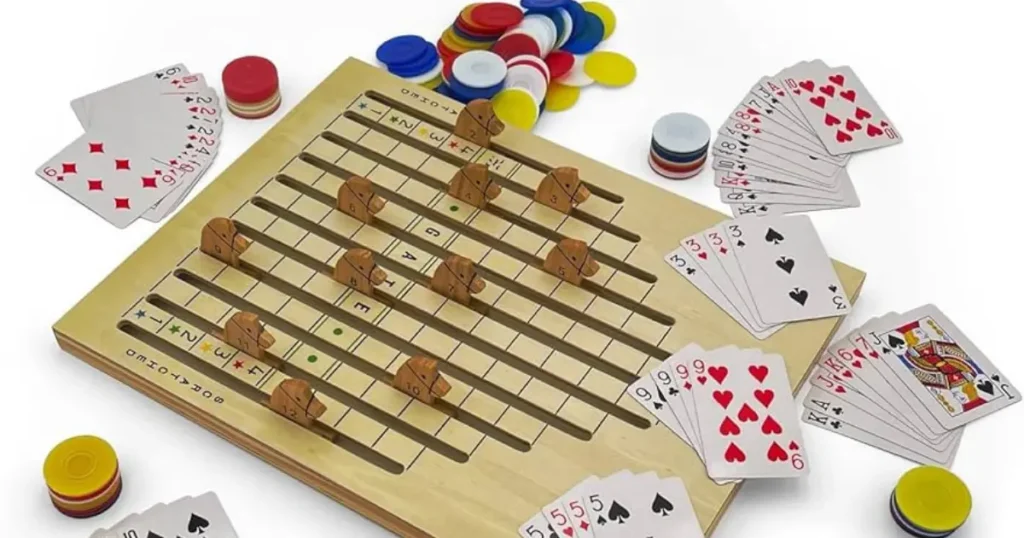
- Game Components: What You’ll Need
- Setup and First Impressions
- Understanding the Mechanics
- The Role of Luck and Strategy
- Social Dynamics and Group Fun
- Pros and Cons
- House Rules and Variants
- Comparisons With Other Racing Games
- Tips for Hosting a Great Game Night
- Real-Life Stories and Anecdotes
- The Future of Classic Board Games
- Conclusion
What Is The Racing Horse Game?
It is a Racing Horse Game is a socially-driven board game designed around horse racing, betting, and dice movements. In essence, the game mimics a horse race on a track where each player holds cards representing various horses. It is a dice roll game that allows players to advance their horses or trigger penalties. They can then take home a chip pot if they’ve backed the horse that won — or payout if their cards fail to make it to the top.
Although the rules are easy, the excitement and tension that it creates aren’t. Every spin of the dice creates excitement and excitement: Will your horse move? Could a chance number hit and result in chips? These are the moments that make a game unforgettable.
In terms of the style of play, The Racing Horse Game is a combination of luck, probability awareness, anticipation, and interaction. It is a favorite for gamers of all ages; however, it is particularly popular with those who love unstructured gameplay and banter.
In contrast to heavy strategies that require you to read rules or track complicated economics, the game can be available to play in a matter of minutes, making it suitable for experienced gamers as well as newcomers.
Origins and History
The roots of The Racing Horse Game are hazy, but this is part of its appeal. It’s part of an old family of dice-driven racing games that first emerged during the mid- to late 20th century. These games were typically played at a leisurely pace between families and friends, often without official packagingplaying with playing cards, a board and a creative interpretation of house rules.
It was not until the later years that officialized versions were released commercially, mainly with names such as The Horse Racing Game, Royal Race, or Track and Field Racing. The version that most modern gamers are familiar with — identified as on BoardGameGeek by the ID 93039. The Racing Horse Game (ID 93039). It is usually acknowledged to be the work of CHH Games and became popular among avid gamers in the latter part of the 20th century.2
In contrast to mainstream games with lengthy rule books, this game relied on a simple and flexible game. This meant that families, friends groups, and gaming groups often made their own tweaks to the game and created a lively variety of variations that are in existence in the present.
Through time, the game has maintained its significance, not because it has changed in any way, but simply because it did not require it to. The game’s structure encourages interactions, humor and uncertainty, which are essential in the attraction of games on a board today.
How the Game Works
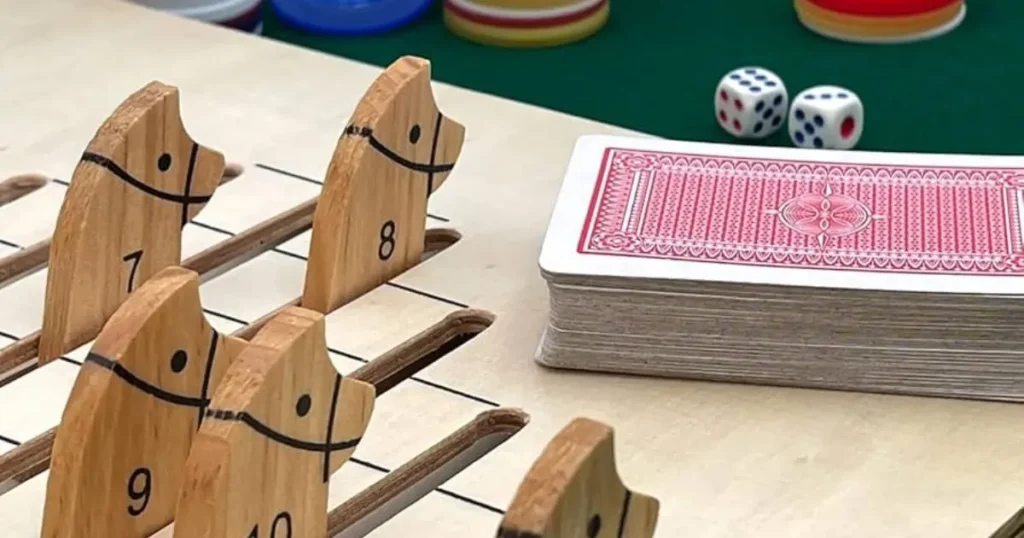
At first impression, The Racing Horse Game appears to be a mix of dice and cards; however, its real magic lies in the way these elements interplay.
The Basic Flow
- Give players cards, each one representing horses with numbers 2-12.
- Scratch (eliminate) four horses before the race by rolling the dice.
- The roll of the dice will advance horses on the track in the course.
- The players with the winning horse cards take home the chips in the pot; other players have to pay.
This basic rhythm — scratch, deal race, rewardit makes the game fun.
The outcomes of dice are important because horses that have numbers such as 6, 7, 8 and 6 are more often seen statistically. This brings luck as well as knowledge of probabilities to the sport, something we’ll look into in the near future.
Game Components: What You’ll Need
Although different groups have somewhat different settings The essential elements are:
Game Board
- A track with space for horses with numbers 2-12.
- Usually, the print is printed with lanes that represent the distance to the line of finish.
Playing Cards
- Standard decks in which Aces, Kings and Jokers are eliminated.
- The remaining cards are horses 2- 10, Jack (11), and Queen (12).
- The cards that players receive make up their bets on horses.
Dice
- Two dice of six sides are rolled to determine outcomes:
- Horses’ movements.
Scratch assignments before the race.
- Fines for falling on numbers that have been scratched.
Chips or Tokens
- The symbol used to represent stakes or points.
- Participants make contributions to the central fund that winners draw from.
Optional Extras
- Horse tokens or horse markers for better visualisation.
- Score sheets to track various races.
Each component contributes to the tension and interactions that create the overall experience.
Setup and First Impressions
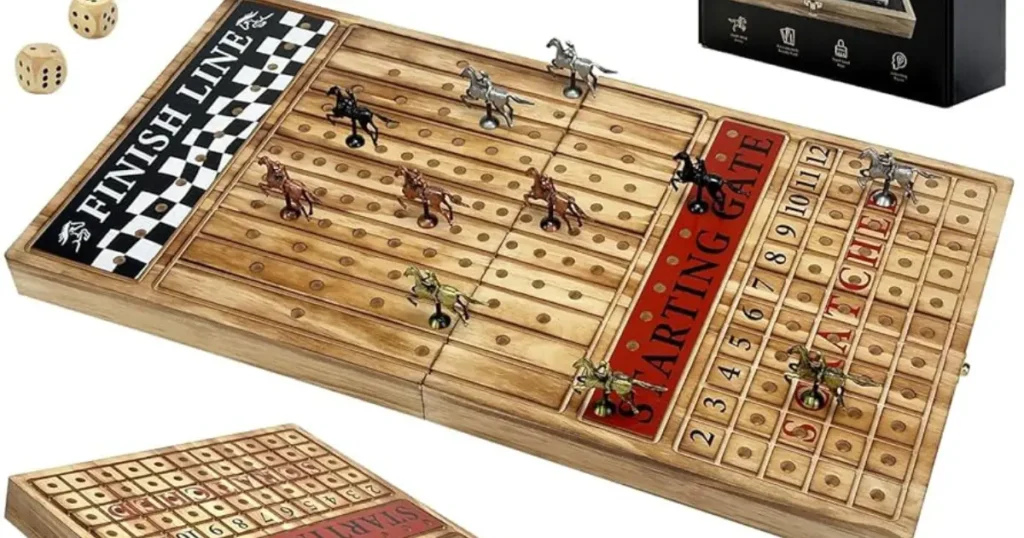
Beginning by playing The Racing Horse Game is extremely simple. Here’s a common set-up:
Prepare the Deck
Remove all Aces, Kings, and Jokers. What’s left are cards that represent horses with numbers 2-12 (with face cards that have numeric value).
Shuffle and Deal
Hand out a similar number of cards for each player. A maximum of four cards is a common practice. However, groups may alter depending on how long they would like the game to be played for.
Place Horses at Start
All horses with numbers start at the start line of the track.
Scratch Four Horses
In the lead-up to the race, the players play dice and roll for scratch (eliminate) four horses. Scratched horses aren’t allowed to move during the main race, but a chance to land on their numbers while playing could cost the players chips.
After the scratch phase is over, the race can begin.
First impressions are generally positive. Players notice how the rules are simple and that the setup is fast, and the roll of the dice immediately brings tension. Because there’s no lengthy process of planning, the game can jump right into having excitement.
In a mere 10 minutes, you’re completely involved in less than ten minutes.
Understanding the Mechanics
Let’s look at how the sport is actually played out, especially the scratch phase and race phase.
The Scratch Phase
Before the race itself, participants must remove four horses. This is accomplished through dice roll:
- Players take turns rolling both dice.
- The sum determines which horse gets scratched.
- This horse is placed in a scratch positionand comes with a penalty.
- Anyone who has cards that match the scratched horse’s name must throw them out—the cards.
This is a time of anticipation and risk, since scratching can alter the course of the race and could dramatically alter who is most likely to win.
The Race Phase
After scratching:
- Players rotate, rolling the dice.
- If the roll is matched to an active horse, the horse will advance one space.
- If the roll matches that of a scratched horse, the participant puts chips in the pot according to the horse’s penalty spot.
- The horse that is the first to finish the race takes home the prize.
It’s a straightforward mechanic; however, every roll is important, particularly as players begin to notice patterns where numbers show frequently.
There’s no decision tree or branching strategy; all you can do is enjoy watching horses scurry towards their goal, motivated by luck and laughter.
The Role of Luck and Strategy
One thing that distinguishes The Racing Horse Game apart is the balance it strikes between the chance of winning and the ease of making decisions.
Luck Is Front and Center
Dice rolls influence both penalties and movement and penalties, which is why luck determines the most important events of the game. For instance, a 7 is statistically more frequently than a 2 or 12 — which affects the way horses move as well as the time players have to pay chips.
The game is easily accessible as you don’t have to know a complex strategy in order to take part. Everyone has the same opportunity to be awed by the action.
Strategic Awareness Still Matters
While luck determines the majority of outcomes, experienced players are aware of:
- Which horses have been scratched?
- What numbers have been featured frequently?
- The number of chips in the pot.
- Odds associated with dice distribution (e.g. 7, vs. 2).
This type of probabilistic awareness is a subtle strategizing layer that isn’t overpowering the player who is not familiar with it.
For those who love games such as Yahtzee or Catan This mix of chance and luck can make The Racing Horse Game feel familiar but distinctive enough to be interesting.
Social Dynamics and Group Fun
The game is best played in groups.
Conversation and Camaraderie
Bets, dice rolls and unexpected outcomes can spark laughter and discussion. The players tease each other when their horses are not performing well, or cheer when the underdogs win.
Group Size
- It is best played with 3 to 6 players.
- The more players, the greater the suspense, pot size, and social interactions.
Emotional Engagement
The players experience both lows and highs every round that create memorable moments. This interaction with friends is one of the reasons why people love this game. It’s about having fun and connecting, and not about the pursuit of perfection.
Pros and Cons
Pros
- Quick setup and rules
- Very social
- The equipment needed is minimal.
- It is suitable for a diverse age range.
Cons
- A lot of reliance on luck
- A limited deep strategy
- Can feel repetitive after many rounds
Despite its drawbacks, the game’s simplicity as well as enjoyable make it a top option for gatherings with friends.
House Rules and Variants
Many groups modify the rules:
- Give more or fewer cards
- Change chip penalties
- Try multiple races to get an experience of a tournament.
- Let bets be placed during the race.
These modifications increase the replay value and increase the fun for teams that are competitive.
Comparisons With Other Racing Games
Comparatively, against other races:
- More simple than the race games that require strategic thinking, such as Flamme Rouge.
- More fun than basic roll-and-move games such as Ludo.
- It is quick to play and easy to setup, which makes it ideal for play with friends.
Tips for Hosting a Great Game Night
- Utilize colourful chips to create a pot that is visually stimulating.
- Participate in multiple races during one session.
- Encourage playful banter
- Rotate dealers each round.
- Introduce house rules slowly.
These tricks increase both enjoyment and participation, making each session memorable.
Real-Life Stories and Anecdotes
Players are often funny:
- A gambler bets on an underdog horse and is successful, and is greeted with a roar of laughter.
- A horse that has been scratched appears on the roll of the dice and forces a player to pay an enormous penalty.
- The teams come up with nicknames for horses and treat each race as miniature-tournaments.
These examples illustrate that the sport is more about sharing fun rather than pure competitiveness.
The Future of Classic Board Games
Classic games such as The Racing Horse Game are returning to the scene. Both casual and avid gamers are turning to easy games that are fun and enjoyable, as well as social games, to replace video games and a variety of strategy games.
The combination of chance, interaction with others and suspense makes sure that this game will continue to be well-known for a long time.
Conclusion
It’s the Racing Horse Game is a classic, easy, and entertaining game that will bring joy, laughter, fun, as well as social interactions to every gathering. It requires no setup, simple rules, and a fun mechanic; it’s a great choice for guys who like playing with friends, a game of probability,y and group bonding.
No matter if you’re playing with family, friends, and colleagues, the game can create memories that you will want to repeat. Play the dice, put your bets,s and take pleasure in the excitement of the race!